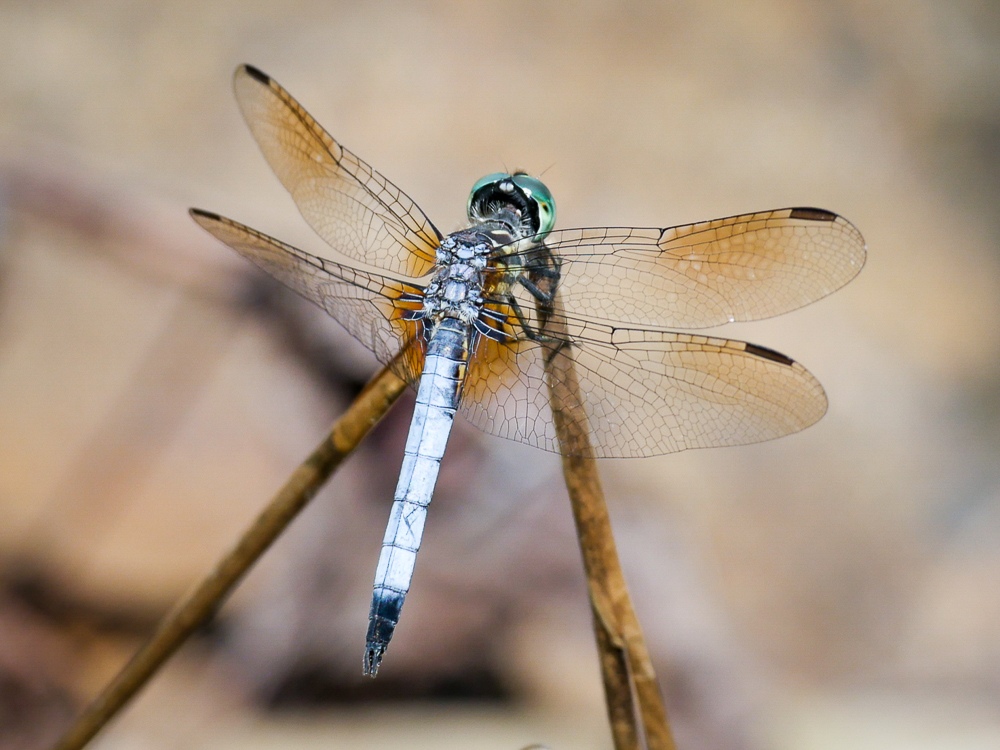
but all I've seen are
bees
flies
one beetle
two just-waking overwintering wasps (in my own house and one of those stung me)
Fragile Forktails almost three weeks ago
and one fat tick embedded in me
I grow impatient for the odonate explosion
"People who daily expect to encounter fabulous realities run smack into them again and again. They keep their minds open for their eyes." (Ken Macrorie)
Showing posts with label Odonates. Show all posts
Tuesday, March 21, 2017
Friday, August 5, 2016
Monday, July 25, 2016
Quite Challenging Indeed!
In answer to a question about cameras, a naturalist in one of my Facebook odonate groups wrote, " Macro photography is quite challenging and takes a lot of time to learn and master."
You got that right, I wanted to write but didn't.
The truth is that I like learning hard things, like my still-feels-new camera and still-newer macro lens. So far, both have outscored me in a contest of skill.
But today's morning foray and some cooperative odes provided a much more successful than usual shoot. I am beginning to think I should just use this lens and forget the other one. I am finally discovering the "sweet spot."
You got that right, I wanted to write but didn't.
The truth is that I like learning hard things, like my still-feels-new camera and still-newer macro lens. So far, both have outscored me in a contest of skill.
But today's morning foray and some cooperative odes provided a much more successful than usual shoot. I am beginning to think I should just use this lens and forget the other one. I am finally discovering the "sweet spot."
Labels:
Blue Dasher,
Blue-fronted Dancer,
Facebook,
Halloween Pennant,
Lake Cheston,
macro,
Odonates
Friday, June 3, 2016
I Saw Some Odonates Today
They were beautiful. This one, for example.
But nowhere are beautiful as these people.
I will remember these long after I forget about odes.
But nowhere are beautiful as these people.
I will remember these long after I forget about odes.
Tuesday, May 31, 2016
Same Bugs, Different Ponds
S, a fellow ode-o-phile, invited me to meet her at friends' ponds on another part of the mountain.
Same elevation, different water, same bugs. (Nineteen species I counted.)
We wondered aloud what makes the difference between there and here (I have seen some odes she hasn't, and she has seen some I haven't).
Like the experts, we have no idea.
But we enjoyed the outing, the beautiful weather, and the generosity of her friends.
That is . . . until I helped flush (unintentionally) a newly emerged ode about which she was curious, and a red-winged blackbird snagged it. Only a few feet in front of me. Despite my frantic screaming (cursing, really) and arm-waving.
Sometimes ode-watching hurts.
Same elevation, different water, same bugs. (Nineteen species I counted.)
We wondered aloud what makes the difference between there and here (I have seen some odes she hasn't, and she has seen some I haven't).
Like the experts, we have no idea.
But we enjoyed the outing, the beautiful weather, and the generosity of her friends.
That is . . . until I helped flush (unintentionally) a newly emerged ode about which she was curious, and a red-winged blackbird snagged it. Only a few feet in front of me. Despite my frantic screaming (cursing, really) and arm-waving.
Sometimes ode-watching hurts.
Friday, May 13, 2016
Another Sewanee Odonate Confirmed!
Hello, Vesper Bluet (Enallagma versperum)!
When I saw the bright yellow thorax and blue final segments on the abdomen, I was puzzled. After poring over my books and Odonata Central, I thought perhaps the light was so bad and my photos so poor that I was mistaken in my initial impression of Vesper. Orange Bluet, I decided.
I posted these to my Southeastern Odes group on Facebook and asked what others thought. Their response was astonishing.
Vesper Bluet at 11:30 in the morning! That makes damselfly species number 28!
When I saw the bright yellow thorax and blue final segments on the abdomen, I was puzzled. After poring over my books and Odonata Central, I thought perhaps the light was so bad and my photos so poor that I was mistaken in my initial impression of Vesper. Orange Bluet, I decided.
I posted these to my Southeastern Odes group on Facebook and asked what others thought. Their response was astonishing.
Vesper Bluet at 11:30 in the morning! That makes damselfly species number 28!
Labels:
Big Day Lake Road Pond,
Damselfly,
Odonates,
Sewanee,
Vesper Bluet
Thursday, May 12, 2016
Surreality
I
Current election cycle.
II
Universe: 13.8 billion years. Odonates: 300 million years. Homo sapiens: 200,000 years.
III
Rainy day tricks of light.
Current election cycle.
II
Universe: 13.8 billion years. Odonates: 300 million years. Homo sapiens: 200,000 years.
III
Rainy day tricks of light.
Thursday, April 28, 2016
Worked Like a Charm (Except for the Focus)
waited till 11:30am, drove out to Day Lake Road, prepped the camera, walked straight to the big pond, went around the curve toward the other side, crept from sunlit spot to sunlit spot, looked at the leaves, and found the Aurora Damsel
Labels:
Aurora Damsel,
Day Lake Road ponds,
Odonates,
Sewanee
Monday, April 25, 2016
Another Record!
When KZ of the Sewanee Biology Department challenged me to create a list of odonates on the Domain, I had no idea I'd still be at it five years later. With pleasure, I sent him an updated list last night, having discovered and photographed a new species for the Domain and county at the Day Lake Road large pond.
The Aurora Damsel is a true beauty: so different from bluets -- no shoulder stripes, somehow seemingly broader and longer. I saw it for less than a minute, just long enough for two snaps, and then it disappeared.
It's a comfort to learn that the Aurora prefers "spring-fed streams, clean lakes, and ponds," according to Ed Lam's Damselflies of the Northeast. I supposed that Lake Dimmick is relatively clear, but I never thought the nearby ponds were.
In any case, I have now photographed 36 species of Anisoptera (dragonfly) and 27 of Anisoptera (damselfly), and given that I thought there was one thing called dragonfly when I started, I'd say it's an accomplishment.
The Aurora Damsel is a true beauty: so different from bluets -- no shoulder stripes, somehow seemingly broader and longer. I saw it for less than a minute, just long enough for two snaps, and then it disappeared.
It's a comfort to learn that the Aurora prefers "spring-fed streams, clean lakes, and ponds," according to Ed Lam's Damselflies of the Northeast. I supposed that Lake Dimmick is relatively clear, but I never thought the nearby ponds were.
In any case, I have now photographed 36 species of Anisoptera (dragonfly) and 27 of Anisoptera (damselfly), and given that I thought there was one thing called dragonfly when I started, I'd say it's an accomplishment.
Labels:
Aurora Damsel,
Day Lake Road ponds,
Domain,
Odonates,
Sewanee
Monday, April 18, 2016
When the air flutters
over and around a pond, it's odonate season in full.
In about an hour an half, I saw Blue Corporals, Common Baskettails, one Comet Darner, Green Darners, one Springtime Darner, Carolina Saddlebags, Black Saddlebags, Fragile Forktails, Lancet Clubtails, and one Common Whitetail.
I watched emerging, mating, patrolling, hawking, guarding, sparring, basking, . . . the whole shebang.
Now I have to learn how to use the camera more seriously.
In about an hour an half, I saw Blue Corporals, Common Baskettails, one Comet Darner, Green Darners, one Springtime Darner, Carolina Saddlebags, Black Saddlebags, Fragile Forktails, Lancet Clubtails, and one Common Whitetail.
I watched emerging, mating, patrolling, hawking, guarding, sparring, basking, . . . the whole shebang.
Now I have to learn how to use the camera more seriously.
Note to self: do not ever drop the lens cap in the muddy water again.
Wednesday, April 1, 2015
These Are My People
It's Odonate season again (Common Green Darners, Fragile Forktails, Blue Corporals, so far), and soon I'll be saving insects from other insects and birds, just because I think everyone deserves a fighting chance.
These people agree.
These people agree.
Saturday, November 8, 2014
Odonate Roundup
Just in case this is truly the end of Odonates for 2014, here are the lows and highs:
- For the third time, a Canon G12 failed.
- A borrowed camera meant telephoto but not macro.
- A purchased old Nikon DSLR with two good lenses (and one bad) and a newly purchased (too small) macro equaled utter dissatisfaction.
- A new Panasonic Lumix took quite a lot of getting used to.
- Two ponds not previously visited, one of which offered much more Odonate diversity that any other body of water, became my go-to spots.
- Nine species added to the Sewanee list (three dragonfly and six damselfly).
- Up-close-and-personal photographs of four Odonates that have previously eluded me.
- Four other species seen and snapped for the first time, but off the Domain.
As of today, these are the species I have seen and mostly photographed on the Domain:
Dragonflies
- Gray Petaltail
- Common Green Darner
- Comet Darner
- Springtime Darner
- Cyrano Darner
- Shadow Darner
- Lancet Clubtail
- Stream Cruiser
- Prince Baskettail
- Common Baskettail
- Clamp-tipped Emerald
- Calico Pennant
- Halloween Pennant
- Double-ringed Pennant
- Banded Pennant
- Swift Setwing
- Eastern Pondhawk
- Little Blue Dragonlet
- Blue Corporal
- Spangled Skimmer
- Golden-winged Skimmer
- Slaty Skimmer
- Great Blue Skimmer
- Widow Skimmer
- Common Whitetail
- Painted Skimmer
- Blue Dasher
- Wandering Glider
- Spot-winged Glider
- Eastern Amberwing
- Blue-faced Meadowhawk
- Autumn Meadowhawk
- Carolina Saddlebags
- Black Saddlebags
- Arrowhead Spiketail
Damselflies
- Ebony Jewelwing
- Swamp Spreadwing
- Amber-winged Spreadwing
- Slender Spreadwing
- Southern Spreadwing
- Great Spreadwing
- Variable Dancer
- Blue-fronted Dancer
- Double-striped Bluet
- Familiar Bluet
- Turquoise Bluet
- Slender Bluet
- Orange Bluet
- Stream Bluet
- Skimming Bluet
- Azure Bluet
- Big Bluet
- Citrine Forktail
- Lilypad Forktail
- Fragile Forktail
- Southern Sprite
- Eastern Forktail
- Rambur's Forktail
Seen Elsewhere
- Black-shouldered Spinyleg
- Flag-tailed Spinyleg
- Powdered Dancer
- Dusky Dancer
- Blue-ringed Dancer
- American Rubyspot
- Twelve-spotted Skimmer (but not photographed -- yet)
Saturday, October 25, 2014
Food for Thought
I
A Great Spreadwing's supper consists of many insects, including colorful beetles, and there are no leftovers.
II
For supper, I am eating beef vegetable soup, without consideration of the cattle on a feed lot or their slaughtering or their butchering or the ways in which the leftovers not suitable for human consumption might be used. I may not be able to eat it all.
III
Discover Life says this about Odonates:
|
IV
Something to ponder: just who is the "devil's" instrument when it comes to eating?
Sunday, October 5, 2014
Walking with Friends
J and B joined me for a walk at Lake Dimmick, where one had been and the other not. He carried a strainer and on occasion scooped the pond or lake bottom for Odonate larvae and other signs of life.
Even though we walked from about 11:30 to 1:15, the temp was still cool and the wind strong. As a result, only the brave were visible: a couple of Swamp Spreadwings, a couple of Calico Pennants, one male and one female Citrine Forktail, several Autumn Meadowhawks (included a mated pair ovipositing), and a number of Common Green Darners.
I didn't get to see the Clamp-tipped Emerald, which I longed to show off, but just as I despaired, four darners appeared (three males, one female), and one hung from sumac, providing just the right seasonally striking contrast.
I had forgotten how enjoyable it is to be in good company!
Even though we walked from about 11:30 to 1:15, the temp was still cool and the wind strong. As a result, only the brave were visible: a couple of Swamp Spreadwings, a couple of Calico Pennants, one male and one female Citrine Forktail, several Autumn Meadowhawks (included a mated pair ovipositing), and a number of Common Green Darners.
I didn't get to see the Clamp-tipped Emerald, which I longed to show off, but just as I despaired, four darners appeared (three males, one female), and one hung from sumac, providing just the right seasonally striking contrast.
I had forgotten how enjoyable it is to be in good company!
Friday, September 19, 2014
Some Fascinating Odonate Information
Courtesy of National Geographic, April 2006
Grab, shake, bite, puncture, punch—that's just the courtship ritual of these dazzling aerobats.

By Jennifer Ackerman
You may have seen their antics on a languid summer day: Somewhere on the reedy fringes of a pond, a male dasher dragonfly pursuing a female, like two hyphens of lightning. Or a tiger-striped spiketail diving, twirling, flashing its gossamer wings, then in a blink, meeting a mate to ascend together into the ether. Or a linked pair of brilliant green darners hovering as one over the dark water, the male towing the female, darting forward, then back, then straight up with the kind of aerial agility of which we masters of the helicopter can only dream.
From a distance, dragonfly rituals of courtship and sex look harmless, even romantic. But a close look at their mating game reveals a harsher tale of sexual harassment and conflict. Take the jewelwing Calopteryx splendens. Some males dispense with courtship altogether and just snatch unwary females while they're warming in the sun—even immature ones, shimmer-fresh after emergence from their larval youth. Others, called "stealers," attack and split mating pairs by ramming, pulling, and biting them; still others, "water lurkers," grab a female in the midst of egg laying so they can have their way with her, even if she drowns in the process. Females, for their part, attempt to escape this boorish behavior by flipping, zigzagging, spiraling upward or downward, submerging in water, fleeing at high speed, or fighting back, sometimes murderously.
Why such a war between the sexes? Scientists seeking clues to the answer are finding in dragonflies a bizarre mix of cooperation and conflict, instinct and experience, which may explain not just their odd reproductive habits but also their dazzling diversity of colors and species.
When my grandmother was growing up, dragonflies were known as devil's darning needles and horse stingers, considered an annoyance by some, a danger by others. In many places the insects are still under suspicion, dubbed finger cutter, horse killer, ear stick, and eye pisser. They are poisonous. They will sew together your lips. They will crawl into your ear and penetrate your brain. They will sting you. They will bite you. They will bring you rotten luck, or worse.
"Not so," says Philip Corbet, a biologist from Cornwall in England. "Dragonflies are neither nuisance nor danger—that is, unless you're a mosquito." Or another dragonfly.
Corbet is fixed on a pair of elegant blue-tailed damselflies on the sunny bank of a small lake in Spain—one azure, one ocher, "both from the species Ischnura graellsi, renowned for having females of more than one color," he says, and also, for the male's distinctly "ungallant" behavior. "To secure a copulation, a male will seize a flying female and sometimes even bite her wings at the base."
This pair, however, is locked in an embrace that can only be described as an ersatz heart.
Anyone who has watched dragonflies mating in the bright air has seen a wonder of evolution, Corbet says. Odonates, as they're called, or "toothed ones," have been around for more than 300 million years, which has given them time to figure all the angles on sex. Judged by their longevity and diversity (6,000 species) and the scope of their distribution (every continent except Antarctica), they're one of nature's great reproductive success stories.
Corbet brings his net close to the coupled pair. He keeps the net's shadow low, then whips the net over with a quick flick of the wrist. Such skillful fliers are dragonflies and damselflies that they often make a mockery of such efforts at capture. (The difference between a damsel and dragon, in a nutshell, is that the damsel is small and slender and holds its wings over its back when at rest; the more robust dragonfly holds its wings outspread.) But Corbet is a master. As a child of six, he fell helplessly in love with the insects. Now in his 70s, with two wings of snow-white hair and a full white beard, he is the doyen of dragonflies and author of the "bible" on the subject.
He pulls the male out of the net and turns him upside down to look at his genital organs.
At the tip of the male's abdomen are its testes; at its base, behind its legs, is a penis and a small swollen pouch for storing sperm. Male dragonflies sport two sets of sex organs, the prerequisite equipment for a mating system that is unique in the insect world. Before he copulates, a male dragonfly must in essence self-inseminate, moving his sperm from the testes to the storage pouch and into the penis. Here comes the tricky part. He must grip a female by the head or thorax and hold her in the tandem position, with claspers at the tip of his abdomen that fit neatly, like a lock and key, with a special plate on her thorax or behind her eyes.
"If it seems that dragonfly biologists are inordinately preoccupied with sex, they may be excused," Corbet says. Sexual behavior is key to understanding how dragonfly species got to be the way they are. And sexual organs are key to their identity. "Slight differences in this clasperplate system are what define some species that are otherwise nearly impossible to distinguish."
Once the pair is in tandem, and the female is receptive to the overtures of her suitor, she will curl the tip of her abdomen around to bring her vagina in touch with his penis, working the pair into that heartlike copulatory position.
"It's a jolly difficult business," says Corbet, "and there's much speculation about how it evolved." Some experts believe that the male originally placed his sperm package on the ground. This was risky, given what Corbet calls the "predatory proclivity" of some female dragonflies to banquet off their partners. Males may have adopted the tandem position to protect themselves from becoming their lovers' prey. Over the ages they evolved ways of keeping their sperm packages safely tucked under their abdomens and, eventually, a complex genital "sperm bank" for storing it there.
So, too, they evolved strategies for effectively guarding their mates and fending off rivals. After sex, many pairs do not disengage but fly about in tandem, the male guarding the female by continuing to grasp her while she lays her eggs. This may serve the female, protecting her from clamoring suitors so she can oviposit in peace.
But there's nothing chivalrous about male sexual behavior. Some males embrace females with spiny claspers in a viselike grip that causes damage. Look closely at the eyes of a female darner, and you may well see dark puncture marks. This sort of abuse appears widespread among some dragonflies. In one study of 12 species of clubtails by Sidney Dunkle, a biologist then at the University of Florida, 88 to 100 percent of all females had holes in their heads, caused by a male's iron hold. The aptly named dragonhunter (Hagenius brevistylus) earned the dubious distinction of inflicting more severe damage than any other dragonfly: The spines of his appendages gouged the female's eyes, punctured and split her exoskeleton, and pierced her head, so that a "maximally damaged" female had as many as six holes of varying sizes punched in her head.
Grab, shake, bite, gouge, puncture, split, punch: It's enough to put anyone off sex.
In a brilliant experiment some years ago, Jonathan Waage of Brown University discovered the Rosetta stone to this strange mating behavior. Waage studied the jewelwing damselflyCalopteryx maculata. First he examined the sperm-storage organ of females after a couple of matings to determine whether sperm from a second mating was added to sperm from the first. He was surprised to find that the amount of sperm hadn't changed. Then he dissected pairs in the midst of copulation and studied their sex organs under an electron microscope. The experiment revealed that a male dragonfly uses his penis not just to transfer sperm to the female, but also to remove sperm left in her storage organ from previous matings. When he curls into that wheel position and begins his energetic genital thrusting, he's actually using his rigid, spoonlike, and sometimes spiky, penis to scrape out rival sperm before he deposits his own.
Such a ploy is necessary, Corbet says, because of female choice and sperm competition. A female nearly always mates with more than one male; it's in her interest to "upgrade" her fertilizations if she can, thereby exercising choice over the paternity of her offspring. Males want their sperm alone to prevail, so they have evolved strategies for purging other sperm and for discouraging mates from copulating with rivals. In this game of sexual chess, the last sperm into the female's storage organ wins by fertilizing her eggs.
Waage's discovery helps explain all sorts of cunning and perfidious dragonfly habits: why males harass females (to spread their sperm around); why they assume that weird heartlike copulatory position (the wheel facilitates the removal of rival sperm); why they guard females, and encourage them to lay eggs directly after mating.
This warring may have a surprisingly "creative" effect, says Ola Fincke, an evolutionary biologist at the University of Oklahoma. "It may be a novel mechanism for generating the different colors found among some females," she says, "and even entirely new species." In Fincke's view, the brilliant diversity of dragonflies may arise not only from adaptation to ecological niches, as with the famous Galapagos finches, but also as a response to sexual conflict.
Fincke studies Enallagma damselflies, known in North America as bluets. Mature female bluets come in two colors, the more common green type and also blue, the usual color of males. Why would females of different colors be maintained in a population? Fincke suspects that sexual harassment offers an answer. To measure harassment in bluets, she uses the "damsel-on-a-stick" technique: She glues live females to a perch and places them at the edge of a small pond, where males congregate. "Females may be harassed as often as five times a minute," she says, "and not just by their own species, but by males of closely related species." Blue females suffer significantly less.
Studies show that females constantly hounded by suitors have lower fecundity. So, in the game of evolutionary one-upmanship, females may have evolved different color forms as a response to harassment. According to one hypothesis, a blue female would be hassled less because she looks like a male. Fincke has another explanation, with some startling implications.
"It may be that a female of rarer color doesn't get harassed as much," she posits, "not because she looks like a male but because she's a less familiar form of female and doesn't fit the male's 'search image' for a mate." In recent experiments, Fincke has shown that young males discover what a female looks like by exposure. If they're reared with green females, they choose to mate with green females; if they're reared with blue ones, they'll go for blue. This suggests a revolutionary idea. Male dragonflies learn; their sexual behavior is not hardwired but more flexible, more "intelligent" than anyone ever imagined.
Like most scientists, Fincke follows questions, one leading to another. In her view, sexual conflict may explain another perplexing mystery: the relatively swift evolution of bluet species—18 new species in the past 250,000 years. Speciation is still poorly understood, and the explosion of new species in this genus in particular is a conundrum. "How do you explain the rapid evolution of dozens of different species of blue-and-black damselflies, all of them occupying essentially the same ecological niche?" she asks. Fincke suspects that females with slightly different thoracic plates are favored in evolutionary terms, because male claspers of some species won't fit with them, so not as many males can harass them by taking them in tandem. In short, sexual harassment sparks the evolution of female plates that differ from the usual, which in turn triggers shifts in the shape of male claspers, in an evolutionary tango that gives rise to whole new species and unexpected variety.
The next time a pair of elegant jewelwing damselflies or feisty scarlet darters cavort in the flecked morning sun, consider it: evolution on the wing, in motion, right before your eyes.
Labels:
damselflies,
dragonflies,
National Geographic,
Odonates
Wednesday, July 30, 2014
A Half Dozen Pleasures in One Day
1. A plethora of cooperative Odonates.
2. A package of old photographs, featuring my blood family and my might-as-well-be-blood family.
3. An ice cream cone with a friend.
4. An email from a cousin.
5. Fresh corn.
6. Two fat cats in one lap.
2. A package of old photographs, featuring my blood family and my might-as-well-be-blood family.
3. An ice cream cone with a friend.
4. An email from a cousin.
5. Fresh corn.
6. Two fat cats in one lap.
Tuesday, June 17, 2014
In the Here and Now
In today's New York Times, Perry Garfinkel describes opening a writing workshop with this direction:
At the top of a page, write the words ‘Here and now I am’ followed by an ellipsis. In the next five minutes write as many sentences as you can, each sentence beginning with ‘Here and now I am.’ The rules: no questions, no stopping, no thinking, no worries about logic or syntax and no cheating off your neighbor.
If you go blank, draw from your senses — what you see, smell, taste, hear, feel.
Here goes:
Here and now I am writing my 2,120th post for My Daily Snap, a ritual that lifts me like a swing, higher and higher, head back, laughing.
Here and now I remember swinging as a child, and I love blogging like that, an infectious addiction, even though my feet hurt.
Here and now, my feet hurt as they have since morning when, over my head a green heron ack-ack-acking across the pond, I slid part-way into the black loam, water soaking my socks, my camera aimed at another new species -- the Southern Spreadwing.
Here and now, I smile, knowing that a famous person, Dennis Paulson, author of a major field guide to Odonates in America, verified my photo on Facebook.
Here and now, I heard the heron's acking as applause, but it's the rush of wings, the gust of air brushing my cheek as a Slaty Skimmer races by, that makes my skin pucker.
Here and now I feel dehydrated, not literally, but metaphorically: spent, I suppose.
Here and now, still tired from looking for bugs, in wet shoes and socks, two cameras slung across my chest and back, I know I'll do it again tomorrow.
Here and now, when I write have nothing to say of consequence other than noting the way the Southern Spreadwing turned a moment toward me as I reached in for a photograph or the way the second lizard, the one on the Lake Dimmick sign, waited and waited and waited as I approached, as if it knew I am no predator.
Here and now, I have nothing to write, I think, but then when I sit at the computer and place my fingers on the keyboard, something happens and text appears.
In the here and now of photowalking and writing I am part of the elements, and I feel whole.
Sunday, June 15, 2014
In Just Ten Days
four new Odonate species seen, photographed, and verified by experts. That makes 34 distinct dragonfly species and 20 distinct damselfly species.
![]() |
| Arrowhead Spiketail at Lake Cheston |
![]() |
| Painted Skimmer at Lake O'Donnell |
| Southern Sprite at Lake Dimmick |
![]() |
| Amber-winged Spreadwing at Lake Dimmick |
Monday, May 19, 2014
Day 15 of 40: Another Day That Changed My Life
Today's prescription for toothache: antibiotic, hydrocodone, sun, Lake Cheston, 13 Odonate species, three snakes of one kind, one camera, one zoom lens, one tripod, 500+ (mostly bad) photographs. Result: less pain, more fun. Prognosis: further study and more practice required.
Tuesday, May 6, 2014
Day 2 of 40: Another Day That Changed My Life
Three hours among Odonates of thirteen species, humans of one (Sewanee-Soon-to-Be-Alums), and one discovery: I cannot hand-hold a 200mm telephoto. Notes to self: put tripod in car; don't sweat missed opportunities; enjoy trying. Till tomorrow.
Subscribe to:
Posts (Atom)